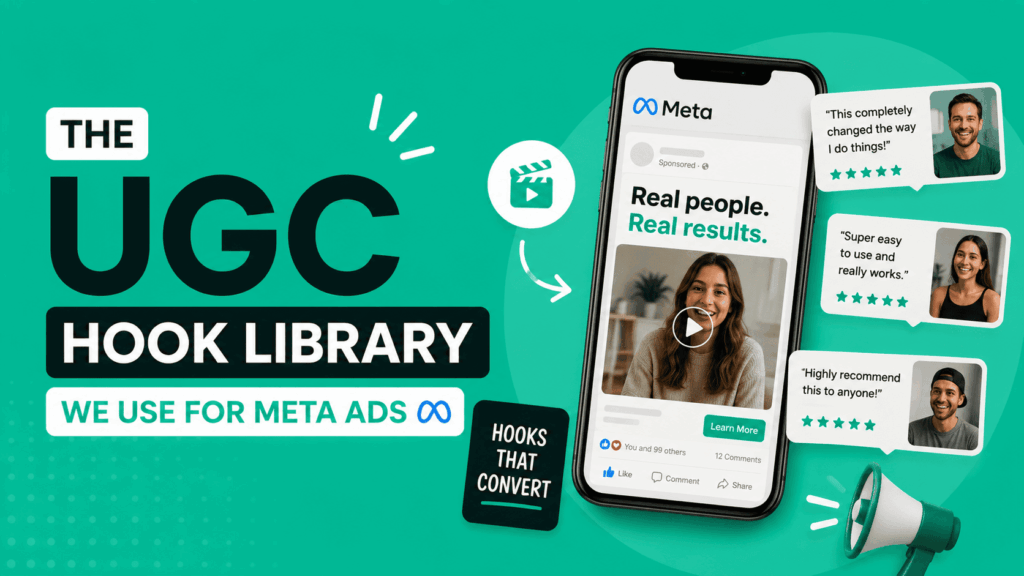
The UGC Hook Library We Use For Meta Ads Key...
Key Issues : UGC Ad Hooks, Facebook Ad Hooks, Meta Ad Hooks, UGC Video Hooks, Ad Creative Hooks
Reading Time: 11 Minutes
UGC ads usually fail or win in the first few seconds.
The hook decides whether someone stops scrolling or keeps moving.
A strong UGC hook should do one of five things:
The best UGC hooks don’t feel like ads.
They feel like something the viewer actually wants to keep watching.
Most brands spend too much time thinking about the middle of the video.
The features.
The benefits.
The product details.
The offer.
But none of that matters if the viewer never reaches that part.
On Meta, Instagram, Facebook, TikTok, and YouTube Shorts, people decide very quickly whether something is worth watching.
That decision usually happens before your product is even explained.
This is why hooks matter.
The hook is not a small intro.
It is the entry point into the entire ad.
Most UGC videos start too slowly.
Common weak openings include:
“Hi guys, today I want to talk about…”
“I recently tried this product…”
“I just received this package…”
“Let me show you something…”
These openings are not always bad, but they are usually too generic.
They don’t create tension.
They don’t create curiosity.
They don’t give the viewer a reason to stay.
A good hook should make the viewer think:
“Wait, what is this about?”
or
“This sounds like me.”
or
“I need to hear this.”
We divide UGC hooks into seven categories.
Each category works differently.
The best hook depends on the audience, product, offer, and stage of awareness.
Problem hooks work because they make the viewer feel understood.
They call out something the audience is already struggling with.
“If your ads are getting clicks but no sales, this is probably why.”
“Your website might be losing more sales than your ads.”
“If your Meta ads stopped scaling, don’t blame the creative yet.”
“If your leads are not converting, your follow-up might be the real problem.”
“If people visit your product page but don’t buy, check this first.”
Use them when the audience is already aware of the pain.
They work well for:
Curiosity hooks create an open loop.
They make the viewer want the answer.
“We found one issue that was quietly killing this ad account.”
“Most ecommerce brands miss this before scaling.”
“This small tracking mistake can completely change your ROAS.”
“Nobody talks about this part of UGC ads.”
“Before you increase your ad budget, check this.”
Use them when you want to pull viewers into an explanation.
They work well for:
Contrarian hooks challenge what the audience already believes.
They work because they create tension.
“Your creative probably isn’t the reason your ads stopped scaling.”
“More traffic is not always the answer.”
“UGC doesn’t work just because it looks authentic.”
“ROAS is not the full picture.”
“Your best ad might not be the one with the most sales.”
Use them when your point of view is different from common advice.
They work well for:
Story hooks pull people in through a real situation.
They feel more natural and human.
“A brand came to us convinced their ads had fatigued. That wasn’t the real issue.”
“We reviewed an account that looked profitable until we checked the tracking.”
“A founder told us their leads were bad. The follow-up system was actually broken.”
“One Shopify store was scaling spend but losing profit every month.”
“We once saw an ad account improve without changing a single creative.”
Use them when you want to sound human, experienced, and credible.
They work well for:
Mistake hooks work because nobody wants to waste money.
They create urgency without sounding fake.
“Stop increasing your ad budget before checking this.”
“Most brands make this mistake when hiring UGC creators.”
“Don’t launch another ad until you’ve checked your tracking.”
“This is why your ROAS looks good but your profit doesn’t.”
“Most local businesses are losing leads after the form submission.”
Use them when the audience is already taking action but doing it incorrectly.
They work well for:
Proof hooks work because they reduce skepticism.
They are especially useful when the audience needs evidence before listening.
“After auditing multiple ad accounts, this pattern keeps showing up.”
“We noticed this issue across ecommerce brands spending on Meta.”
“This one change helped us understand why performance dropped.”
“Here’s what we usually check before blaming the creative.”
“This is the framework we use before scaling campaigns.”
Use them when trust is important.
They work well for:
Direct callout hooks speak directly to a specific audience.
They work best when the audience is clear.
“If you’re a Shopify founder running Meta ads, watch this.”
“If you’re spending on ads but not seeing profit, this is for you.”
“If you’re a local business owner getting leads but no bookings, check this.”
“If you’re hiring UGC creators, don’t skip this.”
“If your agency reports ROAS but not profit, ask this question.”
Use them when targeting a specific niche or buyer.
They work well for:
Don’t choose hooks randomly.
Match the hook to the audience’s awareness level.
Use curiosity or story hooks.
Example:
“Most ecommerce brands miss this before scaling.”
Use problem or mistake hooks.
Example:
“If your ads are getting clicks but no sales, this is probably why.”
Use proof or framework hooks.
Example:
“This is the framework we use before scaling campaigns.”
Use direct callout hooks.
Example:
“If you’re spending on ads but not seeing profit, this is for you.”
A simple formula:
Example:
“Your Meta ads may not be broken, but this part of your funnel might be.”
Another formula:
Example:
“If you’re a Shopify brand struggling with attribution, check this before scaling.”
Another formula:
Example:
“A brand thought their ads had fatigued, but the real problem was hiding on their website.”
A business was producing UGC videos consistently, but most videos were not getting strong watch time.
The creators looked natural.
The videos looked authentic.
But the first three seconds were weak.
Most videos started with slow introductions.
We changed only the opening lines.
Instead of starting with the product, the videos started with the customer’s problem.
The rest of the video remained almost the same.
Performance improved because viewers finally had a reason to keep watching.
The lesson?
Sometimes the video doesn’t need a full rewrite.
It needs a stronger entrance.
Before using a hook, ask:
✅ Does it create curiosity?
✅ Does it speak to a real problem?
✅ Does it sound human?
✅ Is it specific enough?
✅ Would the target audience care?
✅ Does it lead naturally into the rest of the video?
If the hook doesn’t pass these questions, rewrite it.
“Want to grow your business?”
Too generic.
“Hi everyone, today…”
Too weak.
People care about their problem before your product.
Big claims without proof reduce trust.
UGC should feel natural, not rehearsed.
A UGC hook is the opening line or moment that captures attention and encourages the viewer to keep watching.
Usually the first 1–3 seconds matter most. The hook should be short, clear, and interesting.
A good hook creates curiosity, relevance, or tension while sounding natural and human.
Not always. In many cases, starting with the problem performs better than starting with the product.
Test multiple hooks for the same core message. This helps identify whether performance is driven by the opening or the overall concept.
Yes. Hooks are critical for stopping the scroll and improving video engagement on Meta platforms.
Some hook structures work across industries, but the wording should be customized to the audience.
UGC hooks are not just opening lines.
They are the reason someone chooses to watch.
A good hook creates attention.
A great hook creates relevance.
The strongest UGC ads don’t start by talking about the product.
They start by making the viewer feel understood.
Once that happens, the rest of the message has a real chance to work.
5+ years experienced Lead Generation Expert helping businesses generate quality leads, improve conversions, and scale growth through performance marketing.
The UGC Hook Library We Use For Meta Ads Key...
The Storytelling Framework We Use For Founder Content Key Issues...
Behind-The-Scenes Content That Doesn’t Feel Staged Key Issues : Local...
The UGC Hook Library We Use For Meta Ads Key...
The Storytelling Framework We Use For Founder Content Key Issues...
Behind-The-Scenes Content That Doesn’t Feel Staged Key Issues : Local...