The UGC Hook Library We Use For Meta Ads Key...

Key Issues : Med Spa Advertising, Botox Marketing, Medical Spa Lead Generation, Aesthetic Clinic Marketing
Reading Time: 14 Minutes
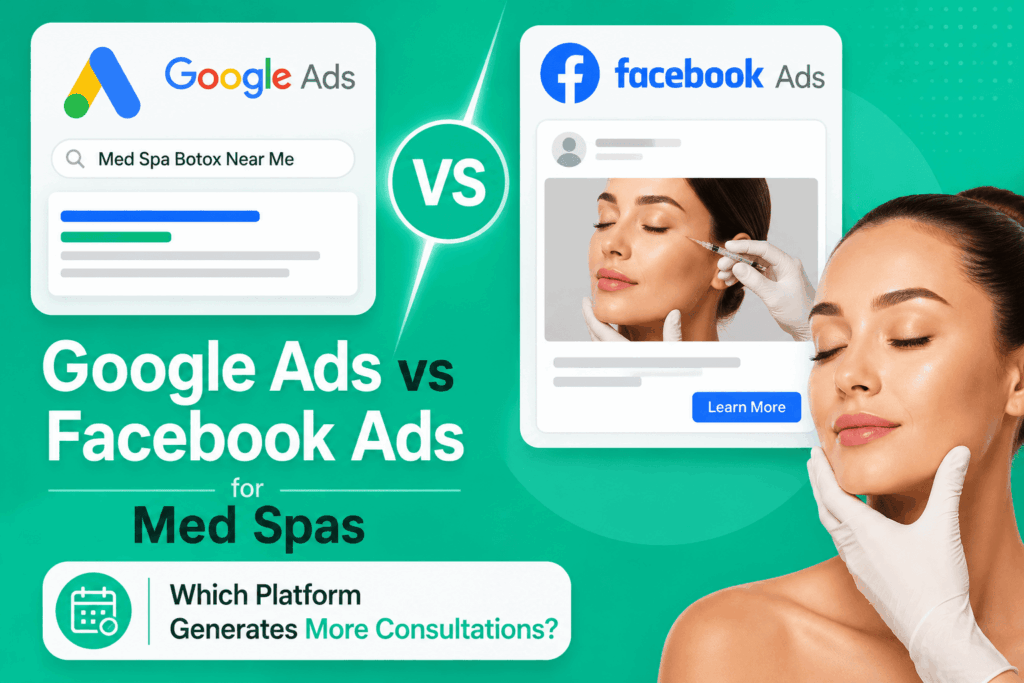
Google Ads and Facebook Ads are not competitors.
They serve different purposes in the patient journey.
Google Ads captures demand.
Facebook Ads creates demand.
If someone searches:
Google usually wins.
If someone is considering treatment but hasn’t started searching yet:
Facebook usually wins.
The best-performing med spas rarely choose one platform.
They understand how both platforms work together.
Captures existing demand.
Patients are actively searching.
Examples:
Intent already exists.
Google helps you capture it.
Creates awareness and demand.
Patients are scrolling.
Not searching.
Examples:
Interest is created before intent exists.
Most med spa patients don’t wake up and immediately book treatment.
The journey often looks like:
Facebook Ad
↓
Instagram Profile
↓
Website Visit
↓
Research
↓
Google Search
↓
Consultation
↓
Treatment
Many clinics incorrectly credit only the final step.
Google performs exceptionally well when:
Examples:
These prospects are often closer to booking.
Facebook excels when:
Examples:
Patients may not be searching yet.
But they can become interested.
Many clinic owners obsess over:
This can be misleading.
Example:
Facebook Lead:
$18
Consultation Rate:
8%
Google Lead:
$65
Consultation Rate:
35%
Which campaign is better?
Usually Google.
Because consultation rate matters more than lead cost.
Always measure:
Not just cost per lead.
Success often depends on:
Creative is everything.
Success often depends on:
Intent matters more than creative.
Trust affects both platforms.
Patients compare:
The clinic with stronger trust signals often wins regardless of platform.
Start with:
60% Google
40% Facebook
Often:
50% Google
50% Facebook
Use both together.
A med spa initially relied entirely on Google Ads.
Consultations were strong.
Growth eventually plateaued.
Search demand created a ceiling.
Adding Facebook and Instagram campaigns created additional awareness.
Months later:
Facebook didn’t replace Google.
It supported it.
Choose Google first if:
✅ Patients actively search for your treatment.
✅ You need consultations quickly.
✅ Local search volume exists.
Choose Facebook first if:
✅ Awareness is low.
✅ Patients require education.
✅ Treatments benefit from visual content.
✅ You need long-term demand generation.
Not necessarily. They solve different marketing challenges.
Google often generates higher-intent leads.
Facebook often generates lower-cost leads.
In most cases, yes.
Consultations and patients, not just leads.
A local service business initially focused only on Google Ads.
Lead quality was excellent.
Growth eventually slowed.
Why?
Search volume created a natural ceiling.
There were only so many people searching.
Facebook Ads helped create additional demand.
The result wasn’t replacing Google.
It was expanding the funnel.
Both platforms played different roles.
Google captures people who are looking.
Facebook creates people who start looking.
The highest-growth med spas understand both roles and build systems that use each platform at the right stage of the patient journey.
The question isn’t:
“Which platform is better?”
It’s:
“Where is my patient in their decision-making process?”
5+ years experienced Lead Generation Expert helping businesses generate quality leads, improve conversions, and scale growth through performance marketing.
The UGC Hook Library We Use For Meta Ads Key...
The Storytelling Framework We Use For Founder Content Key Issues...

Behind-The-Scenes Content That Doesn’t Feel Staged Key Issues : Local...

The UGC Hook Library We Use For Meta Ads Key...
The Storytelling Framework We Use For Founder Content Key Issues...
Behind-The-Scenes Content That Doesn’t Feel Staged Key Issues : Local...