Why Most UGC Ads Fail (And How To Fix Them)...
Key Issues: Meta Ads Not Scaling, Facebook Ads Not Scaling, Meta Ad Scaling Strategy, Facebook Ads Performance Drop, Scaling Meta Ads
Reading Time: 12 Minutes
If your Meta ads are not scaling, the problem is usually not the creative itself.
In our experience, the most common reasons campaigns stop growing are:
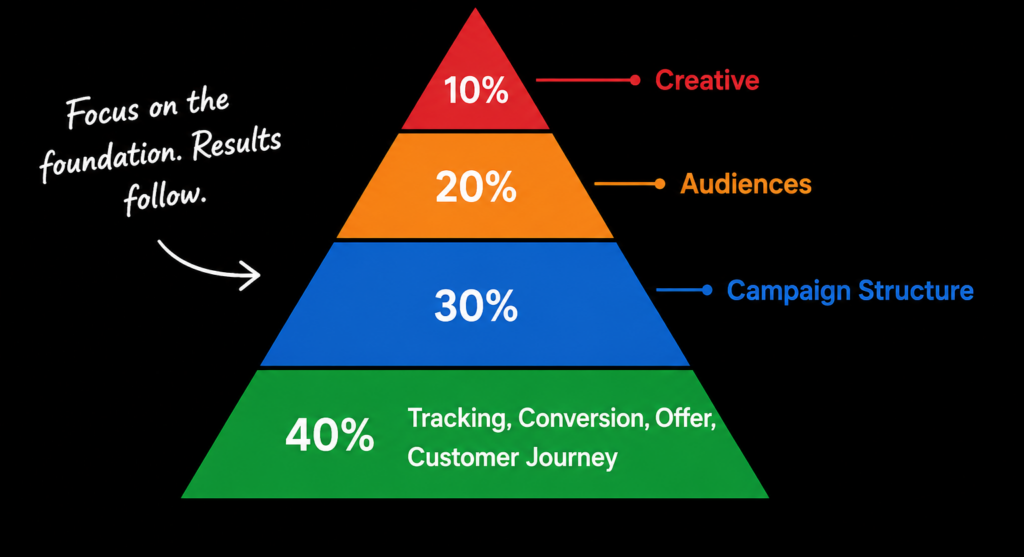
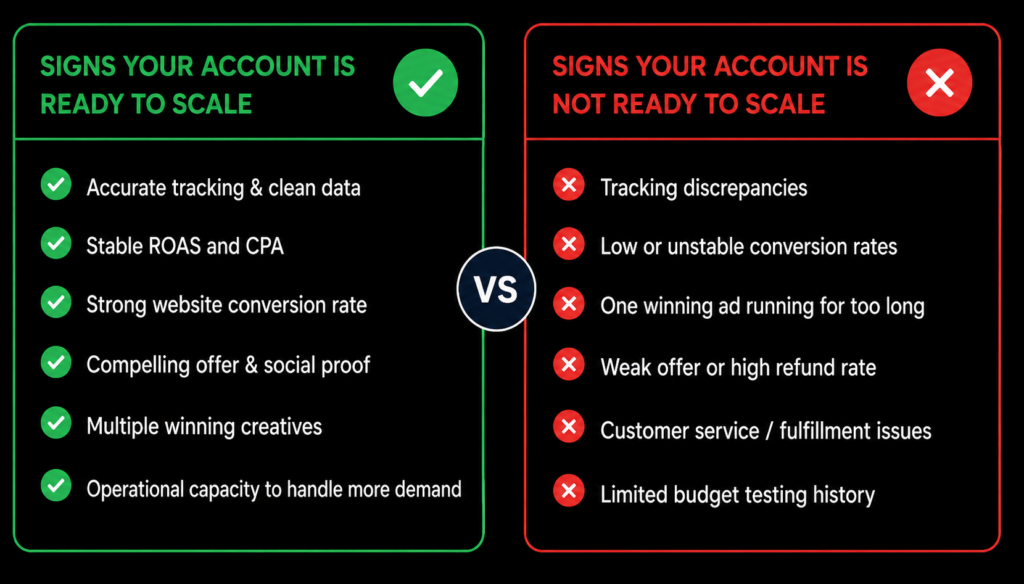
Before launching more creatives, audit the entire customer journey first.
Most people assume scaling means increasing budget.
That’s only part of the equation.
True scaling means increasing revenue while maintaining profitability.
For example:
Spend | Revenue |
$1,000 | $5,000 |
$2,000 | $10,000 |
$5,000 | $25,000 |
This is healthy scaling.
However:
Spend | Revenue |
$1,000 | $5,000 |
$5,000 | $8,000 |
$10,000 | $16,000 |
This is not scaling.
This is simply spending more money.
The goal is profitable growth.
One of the biggest mistakes we see is businesses blaming the thing they can see.
Whenever we evaluate an account, we work through five areas.
This is often the hardest conversation.
Because advertising cannot fix a weak offer.
Consumers compare:
If competitors provide a stronger value proposition, performance eventually suffers.
One of the most common mistakes we see:
Campaign performs well.
Budget doubles overnight.
Performance drops.
Creative gets blamed.
Large budget increases can disrupt optimization.
Gradual scaling tends to produce more stable results.
Recently, we reviewed an account that experienced a sudden drop in ROAS.
The immediate assumption was creative fatigue.
The team prepared new creatives, new hooks, and new campaigns.
Before launching anything, we conducted a tracking audit.
A website update had disrupted a key conversion event.
Meta was receiving incomplete purchase signals.
After correcting the issue, performance stabilized without replacing the original creative.
The lesson?
The most visible problem isn’t always the real problem.
Fast scaling often creates instability.
Traffic cannot compensate for poor conversion rates.
Eventually every creative reaches a limit.
Traffic cannot compensate for poor conversion rates.
Poor tracking creates poor decisions.
Profitability matters more than platform-reported metrics.
Performance can decline because of tracking issues, audience saturation, conversion problems, offer changes, or increased competition.
Different attribution windows, tracking methods, and reporting delays often create discrepancies.
Not always, but large budget increases can create volatility and affect optimization.
New creatives should be launched based on testing opportunities and performance signals rather than a fixed schedule.
Look for declining CTR, increasing frequency, rising CPMs, and decreasing conversion rates.
Yes. Meta relies heavily on conversion signals to optimize delivery.
There is no universal benchmark. Frequency should always be evaluated alongside performance metrics.
This usually points to offer, pricing, landing page, trust, or checkout issues rather than traffic quality.
Not necessarily. Many accounts perform better when existing campaigns are optimized before duplication.
When Meta ads stop scaling, creative is often blamed first.
In our experience, it’s rarely the first place worth looking.
Strong tracking, strong conversion systems, strong offers, and structured creative testing consistently outperform quick fixes.
The businesses that scale most successfully are not chasing hacks.
They’re building stronger foundations.
At Hyclues Media, we help ecommerce brands and local businesses improve attribution, conversion rates, advertising performance, and growth systems so they can scale with confidence
Growth Hacker & eCommerce Ads Expert with 8+ years of experience in scaling brands through performance-driven ad strategies.
Why Most UGC Ads Fail (And How To Fix Them)...
The UGC Ad Brief Template We Use For Creators Key...
The Founder Content Framework For Local Businesses (That Doesn’t Feel...
Why Most UGC Ads Fail (And How To Fix Them)...
The UGC Ad Brief Template We Use For Creators Key...