Why Most UGC Ads Fail (And How To Fix Them)...
Key Issues: Marketing Attribution, Meta Attribution, Shopify Attribution, GA4 Attribution, Ecommerce Tracking
Reading Time: 14 Minutes
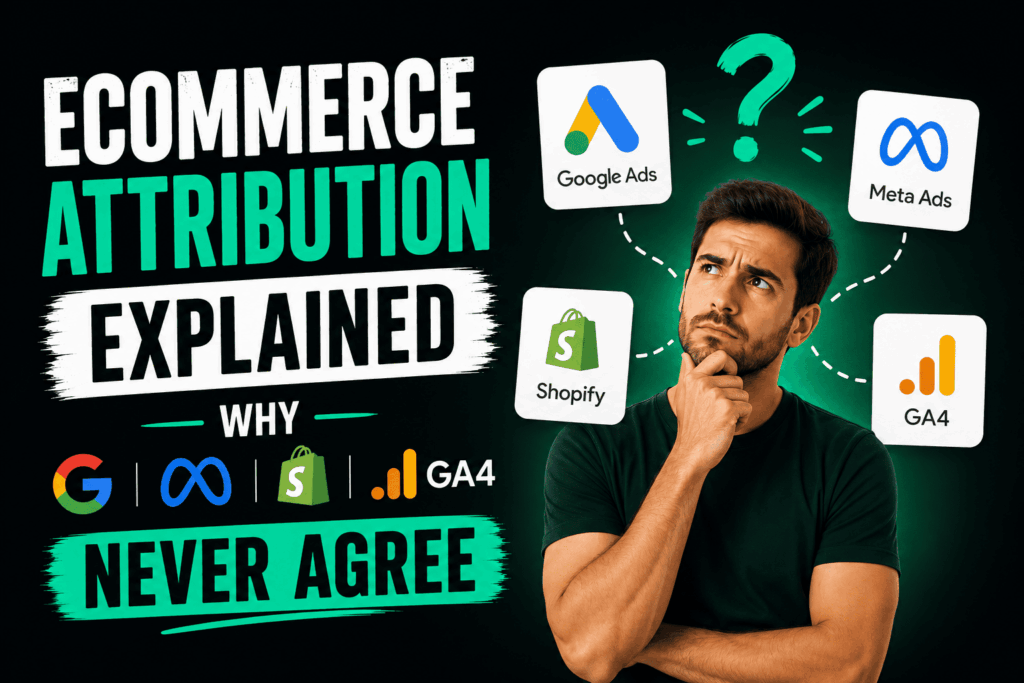
If Google Analytics, Meta Ads, Shopify, and Google Ads all show different sales numbers, it doesn’t automatically mean your tracking is broken.
The reason they disagree is simple:
Each platform uses a different attribution model.
Each platform answers a different question.
As a result, they often assign credit to different marketing channels for the same purchase.
The goal isn’t to make every platform match perfectly.
The goal is understanding what each platform is actually measuring.
You open Shopify.
Revenue says:
$25,000
You open Meta Ads.
Revenue says:
$31,000
You open Google Ads.
Revenue says:
$18,000
You open GA4.
Revenue says:
$22,000
Now you’re staring at four dashboards.
Four different numbers.
One business.
One set of sales.
Which one is right?
The answer is frustrating.
And helpful.
They can all be right at the same time.
Most people assume attribution is about counting sales.
It’s not.
Attribution is about assigning credit.
And assigning credit is surprisingly complicated.
Imagine a customer journey like this:
Day 1: Customer sees a Facebook ad.
Day 3: Customer searches your brand on Google.
Day 5: Customer reads reviews.
Day 7: Customer returns directly and buys.
Now the question becomes:
Who deserves credit?
Facebook?
Google?
Direct traffic?
Email?
This is where attribution models begin to differ.
Let’s look at each platform individually.
Shopify focuses on:
It records:
Shopify is typically the most reliable source for actual sales data.
However:
Shopify isn’t designed to fully explain what influenced those sales.
“How much revenue did we generate?”
Not:
“Which marketing channel deserves credit?”
Meta focuses on influence.
Its job is to answer:
If a customer:
Meta may still claim credit.
Even if Shopify attributes the sale differently.
“Which ads helped create this conversion?”
Not:
“Where did the customer place the final order?”
Google Ads focuses on paid search influence.
If a customer:
Google wants credit.
Even if Meta introduced the customer first.
“Did our advertising contribute?”
Google Analytics 4 attempts to create a broader picture.
It tracks:
But GA4 also uses attribution models.
Which means its answers may differ from Shopify, Meta, and Google Ads.
Let’s follow a real-world example.
Customer sees Meta Ad.
Customer searches Google.
Customer clicks email.
Customer buys directly.
Now watch what happens.
Claims credit.
Claims credit.
Claims credit.
May show Direct.
May split credit.
Everyone believes they influenced the sale.
And they might all be correct.
Attribution models determine how credit is assigned.
The final interaction receives all credit.
The first interaction receives all credit.
Credit is distributed across touchpoints.
Algorithms distribute credit based on user behavior.
Different platforms use different approaches.
That’s one reason numbers rarely match.
A few years ago, attribution was easier.
Tracking visibility was much stronger.
Then came:
Suddenly:
Platforms lost visibility.
Attribution became less accurate.
Reporting differences increased.
This is one reason server-side tracking has become so important.
The wrong answer:
“Trust one platform.”
The better answer:
Understand what each platform is good at.
Each platform serves a different purpose.
Whenever we evaluate performance, we ask five questions.
What does Shopify say?
This establishes business reality.
What does Meta say?
This reveals advertising influence.
What does Google Ads say?
This shows search contribution.
What does GA4 say?
This reveals customer journeys.
Do the trends align?
The numbers don’t need to match.
The trends should.
✅ Shopify revenue trends make sense
✅ Meta performance trends are logical
✅ GA4 traffic patterns align
✅ Tracking audits pass validation
✅ Revenue values remain consistent
❌ Massive reporting discrepancies
❌ Sudden conversion spikes
❌ Revenue values look unrealistic
❌ Website recently updated
❌ Tracking recently changed
A growing ecommerce brand believed Meta was dramatically over-reporting revenue.
The team stopped trusting Meta entirely.
After reviewing attribution paths, we discovered something important.
Meta was introducing many customers at the beginning of the buying journey.
Google often captured them later.
Shopify frequently recorded the final visit as Direct.
The issue wasn’t bad tracking.
The issue was attribution misunderstanding.
Once the team understood how credit was being assigned, reporting became far less confusing.
Most businesses spend too much time asking:
“Which platform is right?”
A better question is:
“What is each platform trying to tell me?”
The answer often leads to better decisions.
Meta uses attribution models that often assign credit differently than Shopify.
GA4 measures sessions and attribution differently from Shopify’s order reporting.
For actual revenue and orders, Shopify is typically the best source of truth.
Sometimes. But attribution differences often explain a large portion of discrepancies.
It improves signal quality and can reduce some tracking loss.
No.
The goal is improving accuracy, not achieving perfection.
Both platforms may have influenced the same customer journey.
No. Small differences are normal.
Attribution is one of the most misunderstood areas of ecommerce marketing.
When platforms report different numbers, many businesses assume something is broken.
Often, nothing is broken at all.
Different platforms simply assign credit differently.
The businesses that scale successfully aren’t the ones chasing perfect attribution.
They’re the ones who understand what each platform is measuring and use that information to make smarter decisions.
Growth Hacker & eCommerce Ads Expert with 8+ years of experience in scaling brands through performance-driven ad strategies.
Why Most UGC Ads Fail (And How To Fix Them)...
The UGC Ad Brief Template We Use For Creators Key...

The Founder Content Framework For Local Businesses (That Doesn’t Feel...
Why Most UGC Ads Fail (And How To Fix Them)...
The UGC Ad Brief Template We Use For Creators Key...