Why Most UGC Ads Fail (And How To Fix Them)...
Key Issues: Facebook Ads Budget Scaling, Meta Ads Performance Drop, Facebook Ads ROAS Dropped After Increasing Budget
Reading Time: 6 Minutes
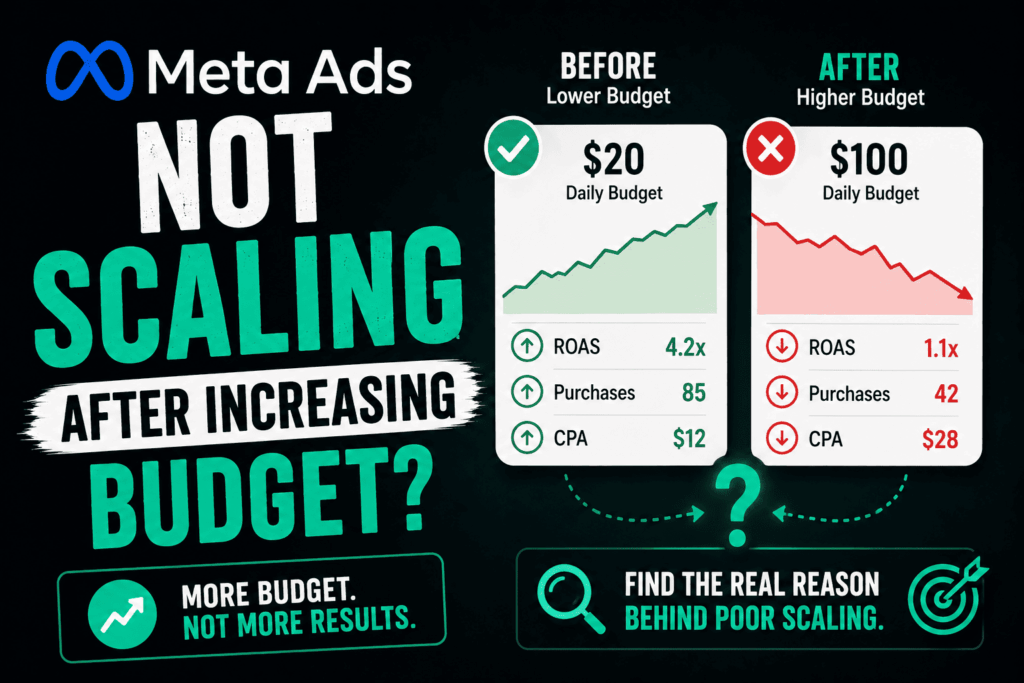
If your Meta ads stopped performing after increasing your budget, the issue is usually not the budget increase itself.
The real problem is often one of these:
In other words, the budget increase exposed an existing weakness in the system.
The campaign performs well.
Results look great.
ROAS is strong.
The natural response?
“Let’s increase budget.”
A day later:
ROAS drops.
CPA increases.
Performance becomes unstable.
Then comes the conclusion.
“The budget increase broke the campaign.”
Not necessarily.
In most cases, the budget increase simply revealed that the account wasn’t ready for more volume.
Think of it like opening a floodgate.
If the system underneath is strong, it handles more traffic.
If the system has weaknesses, they become visible immediately.
When Meta spends $100 per day, it has a relatively small task.
Find enough people to generate profitable conversions.
When you suddenly increase that budget to $500 per day, Meta’s job becomes much harder.
The platform now needs:
And it needs them quickly.
The challenge is that not all audiences contain unlimited demand.
At some point, Meta begins reaching people who are less likely to convert.
That’s when performance starts changing.
One of the most common causes.
Many businesses assume scaling is simply a matter of spending more.
But audience size matters.
If you’re targeting a narrow audience and suddenly double or triple spend, Meta may struggle to find enough high-quality opportunities.
The result:
Meta’s algorithm constantly learns from conversion signals.
Large budget changes can disrupt that process.
When significant changes occur, the campaign may enter a new optimization phase.
During this period, performance often becomes less predictable.
This doesn’t necessarily mean the campaign is broken.
It means Meta is adjusting.
Advertisers panic after 24 hours.
Then they:
Now the algorithm has even less stability.
This is an issue many businesses overlook.
The ad account might be working perfectly.
The website isn’t.
At lower volumes, conversion issues often remain hidden.
At higher volumes, they become obvious.
Common issues include:
More traffic doesn’t solve conversion problems.
It magnifies them.
Some offers scale easily.
Others don’t.
When a campaign begins reaching broader audiences, your value proposition matters more than ever.
Ask yourself:
Why should somebody choose you?
If the answer isn’t obvious, scaling becomes difficult.
Strong offers often include:
Advertising can create attention.
The offer creates action.
This is one of the most expensive hidden problems.
Many advertisers increase budgets based on reporting they believe is accurate.
But if tracking is broken, decisions become unreliable.
Common examples:
Before scaling, verify that the data you’re using is trustworthy.
Whenever we increase spend, we follow a simple process.
Verify tracking.
No exceptions.
Review website conversion rates.
If conversion rates are declining, increasing spend is usually premature.
Evaluate audience size.
Review creative diversity.
Do we have multiple winning creatives?
Or are we relying on a single ad?
Scale gradually.
Avoid dramatic increases whenever possible.
There is no universal rule.
However, gradual increases tend to produce more stable outcomes than aggressive jumps.
The objective is not to force Meta to spend more.
The objective is to help Meta find additional profitable opportunities.
Those are two different goals.
✅ Stable ROAS
✅ Consistent conversion rates
✅ Strong tracking
✅ Multiple winning creatives
✅ Healthy audience size
❌ Tracking discrepancies
❌ Declining conversion rates
❌ One winning creative
❌ High frequency
❌ Weak offer
We recently reviewed an account that experienced a significant ROAS decline immediately after increasing budget.
The team believed the increase itself had caused the problem.
After auditing the account, we found a different issue.
The website conversion rate had already been declining for several weeks.
At lower spend levels, the decline wasn’t obvious.
Once traffic increased, the problem became impossible to ignore.
The lesson?
The budget increase didn’t create the issue.
It exposed it.
Higher spend requires Meta to find additional conversion opportunities. If audience size, tracking, conversion rates, or offer quality are weak, performance can decline.
Large budget increases can disrupt optimization and create volatility.
Allow sufficient time for performance to stabilize before making additional changes.
Higher spend often requires Meta to reach less efficient segments of an audience.
The answer depends on campaign structure, audience size, and account maturity.
Most advertisers believe budget increases cause performance drops.
In reality, budget increases often expose problems that already existed.
The campaign wasn’t broken by scaling.
The campaign simply wasn’t ready for it.
Before increasing spend, make sure your tracking, website, offer, audience, and creative foundation are strong enough to support growth.
Growth Hacker & eCommerce Ads Expert with 8+ years of experience in scaling brands through performance-driven ad strategies.
Why Most UGC Ads Fail (And How To Fix Them)...
The UGC Ad Brief Template We Use For Creators Key...

The Founder Content Framework For Local Businesses (That Doesn’t Feel...
Why Most UGC Ads Fail (And How To Fix Them)...
The UGC Ad Brief Template We Use For Creators Key...